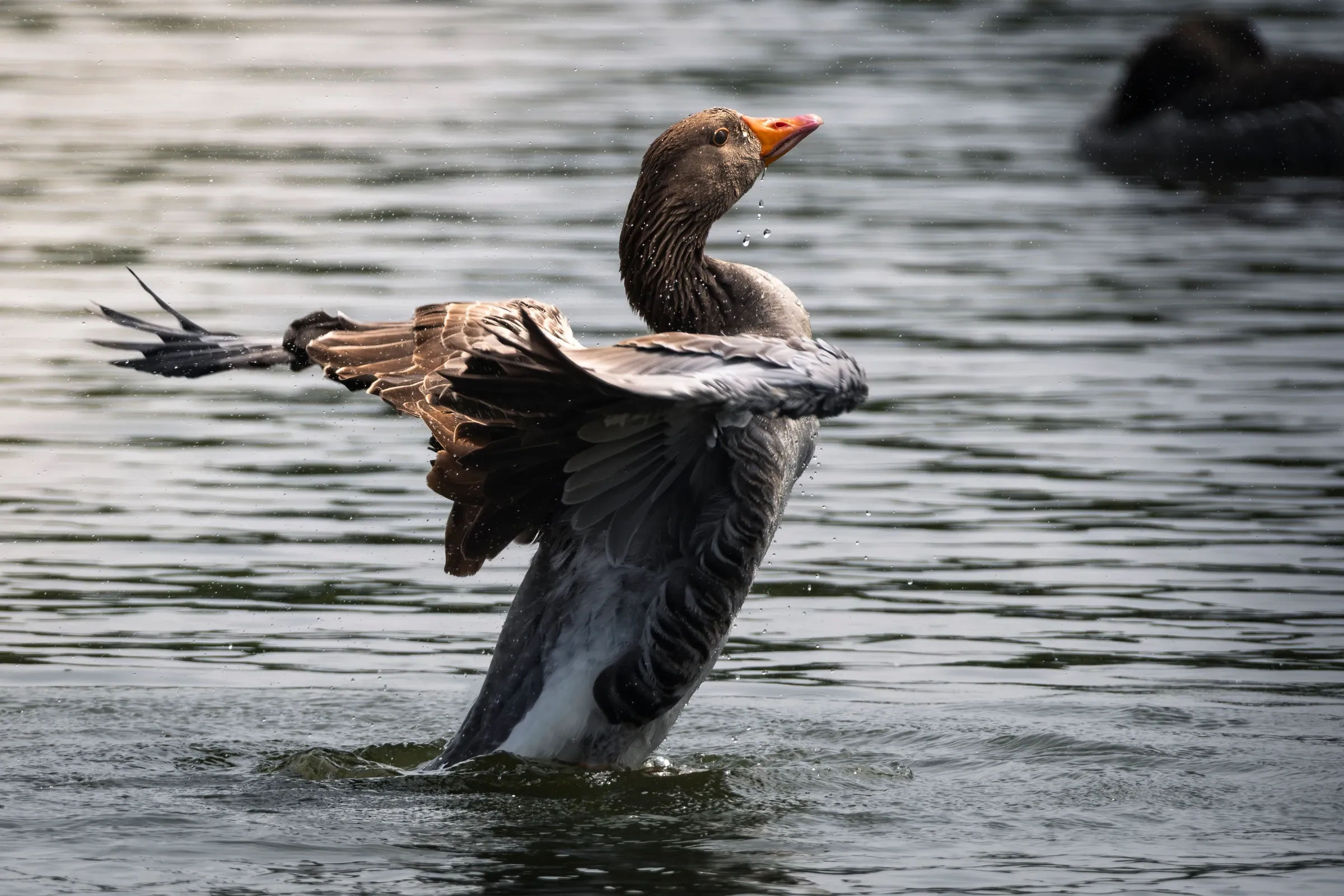
I shoot with the same setup for two completely different subjects: cars on the racetrack and birds in the field. Fujifilm X-T5, Fujinon 150-600mm, both times. It's been my go-to lens for a while now for anything far away and fast-moving, and I'm genuinely happy with it.
With cars, most of the work is done before I even press the button. You know where the corner is, roughly how fast they're coming, and after a few laps you know the rhythm. Panning becomes mostly a matter of repetition: lower the shutter speed, move with the car, press the shutter at the right moment. With this lens, that goes right almost every time.
Birds are a different story, though the overall balance still leans positive. Once the camera has locked onto a bird, it tends to stay with it well, even when the bird bolts. The tracking itself works fine.
Where I do run into something is the very first focus lock. Every now and then, honestly not often, the lens can't find a bird that's sitting completely still on a post, even with a bare background and the focus limiter already set to 5 metres and beyond. That's pretty much the one item on my wish list: a bit faster and more certain on that first lock.
I looked into where that comes from, and it turns out I'm not the only one seeing it. The X-T5 has a non-stacked sensor. Fujifilm's own X-H2S has one, good for 40 frames per second at full raw resolution with autofocus retained, and photographers who shoot a lot of birds tend to point to that body as noticeably quicker on this specific point, same lens mount, same 150-600mm just mounted on it. Makes sense too: at 600mm you're looking through a field of view of exactly 2.7 degrees. Other users of this lens report regularly losing the bird in the viewfinder at 600mm, or even repeatedly missing the frame altogether, something that rarely happens at 400mm. So just getting a bird into frame is already a small feat, let alone having the camera nail focus on it afterwards.
For anyone considering a different system, the same names keep coming up: a Nikon Z8 or Z9 with the 180-600mm, a Sony a9 with the 200-600mm G, or a Canon R5 II with the 100-500mm are frequently mentioned for this kind of work. All full system switches, though, so not something I'd consider over one occasional missed moment.
What I find more interesting is what's coming within my own system. Fujifilm's X-T6 hasn't launched yet, rumours point to September this year, with a new processor and possibly a partially stacked sensor. Exactly the kind of upgrade that could take care of this one wish. Nothing official yet, so I'm not counting on it, but it's good to know something's on the way.
Until then, not much changes about how I work. The sharpness of this lens is excellent, the weight is very manageable given the reach, and by far most sessions still deliver a solid set of good photos. That particular bird on that particular post has long since flown off. Hopefully the next one is a bit more patient.